
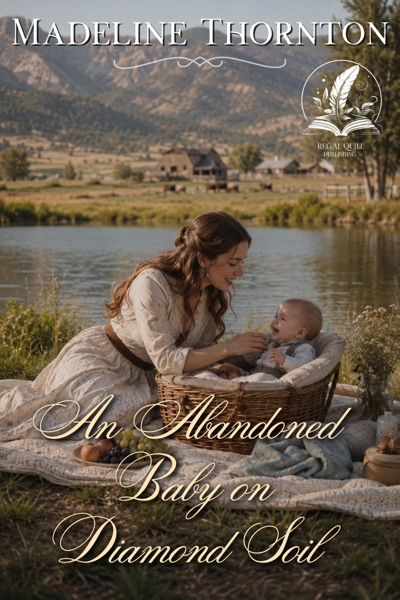
Three years later
By the time the elephant came into view, Anne had already wriggled halfway out of Caleb’s arms.
“There,” she gasped, pointing so hard her whole body joined in. “Papa, there.”
“I see it,” Caleb said, tightening one arm around her before she launched herself into the sawdust and boot heels around them. “That doesn’t mean you get to run at it.”
Anne twisted to look at him with outraged two-year-old dignity. Her dark curls were already escaping the ribbons Eliza had tied that morning, and one pink-cheeked hand was sticky with peppermint because Caleb had given in to her pleading too early in the day and was now pretending to regret it.
Eliza laughed and slipped her hand into the crook of Caleb’s free arm as they moved with the crowd along the fairground lane.
Silver Creek looked different than it had the first time she came to see the circus with her father, but not so different that the old ache did not stir. The same bright canvas tents rose against the sky. The same smells drifted together in warm, dizzying layers—trampled grass, roasting meat, sugar, horse sweat, lamp oil, dust. The same calliope music floated thin and jaunty above the hum of voices and children’s laughter. Men in hats and good Sunday coats stood near the game booths. Women in light summer dresses gathered in little knots to talk. Boys darted through the crowds with apples and paper flags in hand as though the day belonged especially to them.
It did something strange and tender to her heart to stand there now not as Thomas Whitcomb’s unmarried daughter, but as Caleb’s wife and Anne’s mother with another baby turning slow and steady beneath her hand.
She rested her free palm lightly over the rounded swell of her belly and smiled despite the sudden sting behind her eyes.
“You’re thinking hard,” Caleb said.
She looked up at him. “Am I?”
“You are. I know the look.”
Anne, who had no patience for adult feeling when an elephant stood within sight, patted Caleb’s cheek and announced, “Big.”
“Yes,” he said. “Still big.”
Eliza smiled at the two of them, then looked ahead where Lillian and Samuel were waiting near the rope line. Samuel, nearly four and all restless legs and sharp bright curiosity, had his hat pushed back on his head and an expression of utter concentration as he explained something important to his mother about the elephant’s tusks. Lillian listened as if the fate of the nation depended on it.
The sight of them together still touched Eliza every time.
Samuel would always hold a special place in both her and Caleb’s hearts. He had come into their lives in fear and secrecy and left a mark of joy behind him that no time would change. Now he looked sturdy and inquisitive and full of questions, with Arthur’s dark eyes and Lillian’s chin and none of the hunted uncertainty that once clung to him.
When they reached them, Samuel turned at once. “Anne’s too little to ride the pony cart.”
“I wasn’t going to,” Anne said, offended.
Samuel gave her the patient look of an older child burdened by younger cousins and close friends. “You’d cry anyway.”
“I wouldn’t.”
“You would.”
Anne buried her face in Caleb’s shoulder in insulted silence.
Lillian laughed. “You see what I live with.”
“You encourage him,” Eliza said.
“I certainly do.” Lillian looked Samuel over with open affection. “It’s one of my pleasures.”
They spent the next hour moving through the circus grounds together, and for a little while Eliza let herself sink into the easy happiness of it without measuring it against what had come before. Caleb bought Anne a paper windmill she promptly tried to chew. Samuel insisted on showing Lillian and Eliza the acrobat tent as if he had some personal stake in the performance. They all stood together through the riders and the clowns and the trained dogs that sent Anne into shrieks of delight so loud the woman in front of them turned twice to smile.
At one point Caleb leaned down and murmured near Eliza’s ear, “This is where you first fell in love with me.”
She turned her head and looked at him. “That is not how I remember it.”
“No?”
“No. I remember being cornered behind a tent and then rescued by a man who looked too serious to be trusted.”
He smiled without shame. “And yet you married me.”
“I made a desperate bargain.”
“You looked smitten from the start.”
Lillian, overhearing enough to know mischief when it was being made, said, “I remember that day very well, and Eliza did stare after you like a woman in a storybook.”
Eliza laughed and felt herself flush all the same. “You are both liars.”
“Not me,” Caleb said. “I’m a respectable married man.”
“That is not what Mr. Owen says,” Samuel put in solemnly, and that made all four adults laugh hard enough to draw a few glances from the row ahead.
When the performance ended and the crowd began spilling back out into the fairground lanes, Eliza lagged a step behind the others for just a moment.
The late afternoon light had turned softer and richer. Dust drifted gold in it. Somewhere behind her the calliope started again. A little girl in a blue sash skipped by with her father’s hand in hers, laughing at something only the two of them knew. And just like that, Thomas was there in her thoughts so vividly that she had to stop walking.
She saw him as he had been that first day. Proud to have surprised her. Pleased by her delight. Standing a little apart while she ran ahead with Lillian toward the candy stand, thinking perhaps that life would always make room for one more summer, one more outing, one more chance to say the important things later.
Caleb came back for her at once, because he always noticed when she had fallen behind.
“You all right?”
She nodded, though tears had risen anyway. “I was thinking of my father.”
Understanding settled over his face. He reached for her hand and held it without speaking.
“I wish he could see this,” she said quietly.
Caleb looked at Anne, now in Lillian’s arms and trying to grab Samuel’s hat, then at the bright scatter of tents and people all around them.
“I think he can,” he said.
The answer was simple. She loved him for that.
They walked on together after that, slower now, drifting through the fairgrounds while the children tugged them toward every stall with striped awnings or painted signs. Lillian stopped to buy Samuel a sugar twist. Caleb won Anne a small stuffed rabbit after three tries at a toss game he claimed was crooked. Eliza took the chance to sit for a minute on a bench beneath a cottonwood while the baby inside her kicked once in protest at the long day.
Lillian came to sit beside her while the men stood a few yards off with the children.
“You’ve been smiling to yourself for the last ten minutes,” Eliza said.
Lillian looked out toward Samuel and Anne, who were trying to decide whether the rabbit belonged more properly to one child or the other. “Have I?”
“Yes.”
“That’s because I’ve news.”
Eliza turned to her at once.
Lillian’s face still held traces of old grief. Eliza thought it always would. Yet time and work and the return of safety had changed her too. She looked stronger now, less haunted, more fully rooted in her own life again.
“I’m coming back to Redstone Ridge,” Lillian said.
For one second Eliza only stared at her.
“What?”
Lillian laughed at her expression. “I know. It’s unexpected. But it’s time.”
“You mean to visit?”
“No. I mean to come home.”
The words landed with such sudden happiness that Eliza reached for her hand before she even knew she meant to.
“What about Silver Creek? The mine? Arthur’s share?”
“Owen is managing the mine with Mr. Talbot’s brother for the day-to-day work, and I’ve hired another man to oversee the books and the shipments.” Lillian looked calm now that she had finally said it aloud. “I’ll go back when I need to, and Samuel will have every right to step into his father’s place if he wants it when he is grown. But I do not want to raise him there alone forever. I want him near family and near people who loved Arthur for himself. And I…” She paused and smiled a little. “I would like to be home too.”
Eliza laughed, and this time the tears that sprang up were entirely joyful.
“That’s the best news I have heard in months.”
Caleb and Samuel, seeing something on their faces, came closer. Anne had the stuffed rabbit now and no intention of surrendering it.
“What happened?” Caleb asked.
“She’s moving back,” Eliza said, still half laughing with delight. “Lillian is moving back to Redstone Ridge.”
Caleb looked at Lillian. Then his whole expression opened with the same gladness Eliza felt. “Are you?”
“I am.”
“That’s a fine idea.”
“I thought you might say so.”
Samuel, catching only the word back and nothing of the larger adult meaning, asked, “Back where?”
“Back home,” Lillian said, drawing him close with one arm. “To Redstone Ridge.”
He considered this. “Will Anne still steal my things there too?”
“Probably,” Eliza said.
“I do not steal,” Anne announced.
Samuel looked at Caleb with the long-suffering dignity of a child already used to her ways. “She does.”
The adults laughed again.
Once the first excitement settled, they found a quieter stretch of ground at the edge of the fair where the grass ran down toward the creek and the crowd noise softened into something easier. The children played nearby under watch, Samuel showing Anne how to float clover blossoms in a puddle left by the pump while she solemnly ruined each experiment by stomping in it.
The four of them sat in the lengthening light and began, almost without meaning to, to make plans.
“If you come back,” Eliza said to Lillian, “you ought to have some part in the new company. You know the business side better than most anyone we could ask.”
Lillian nodded slowly. “I was thinking the same. If the town means to do this properly, it will need more than men with shovels and bright notions.”
Caleb stretched his legs out in the grass and looked toward the children. “There are enough sensible people involved now that it might actually be done right.”
And that, Eliza thought, was the miracle of it.
After all the blood and greed and lies, Redstone Ridge had chosen not to let the diamonds beneath the land destroy it. After months of talk and meetings and hard argument, the townspeople had agreed that some portions of the land would be mined under strict community control. The money would go toward a new schoolhouse first. After that, a new church. Repairs to roads, wells, fencing, and a proper doctor’s office so women would not have to ride half a day for every birth and fever. Caleb had worked with Walter, Branson, Owen, and the others on the practical side of it. Eliza had spent more hours than she could count over ledgers, rights, contracts, and plans. They meant to do it openly, lawfully, and in a way that left the land still belonging, in the end, to the people who lived on it.
“It feels strange sometimes,” she admitted, “that all of this rose out of such ugliness.”
Lillian looked out over the grounds, where the circus tents glowed warmly against the late sky. “That may be why it matters that it turns into something better.”
For a little while they spoke of smaller things too.
Of Margaret and Branson, who now seemed to have been married forever and not merely a few years. Of Walter, who still lived half in the barn and half in everyone else’s business and would deny both. Of Owen, who had taken to mine management with a seriousness no one would have predicted from the man he once was at twenty. Of the trial, which had ended as justly as such things ever do.
Blackwell, Gideon, and Silas were still in prison and would be for years to come. Rufus had died before he could answer in court for what he had done, which remained a kind of unfinished bitterness in the story no law could now repair. Still, enough had been proved. Enough had been named. Thomas Whitcomb and Arthur Cross had not been forgotten nor dismissed as accidents of fate after all.
When the shadows lengthened and the first lamps began to flare across the fairgrounds, Eliza rose slowly from the bench and stood watching the children.
Anne had finally persuaded Samuel to let her hold his hand while they walked along the creek bank. The two of them moved with all the grave concentration of children entrusted with a task they did not understand but meant to perform nobly. Samuel talked the entire time. Anne answered only now and then, mostly by pointing at things and insisting they be noticed.
Eliza rested one hand over her belly and felt the familiar answering flutter from within.
She thought of the years behind them and the years still coming. Of the first time she saw Caleb behind the circus tents in Silver Creek. Of the barn proposal. Of Samuel’s basket on the porch. Of fear and misunderstanding and the terrible clearing where she thought she might lose everything at once. Of waking to Caleb beside her and finding that love, once admitted, could still survive all the places where fear tried to choke it.
Then she looked at Caleb.
He stood a little apart from Lillian now, watching the children with his hands in his pockets and the evening light along one side of his face. Time had settled him more deeply into himself. There was still sorrow in him, because there always would be, but it no longer ruled the shape of his days. He looked like a man at home in his own life.
She went to him and slipped her hand into his.
He looked down and smiled. “There you are.”
“I love you,” she said.
The words came easily now. Not because they meant less for being often said, but because they meant more each time.
He held her gaze for a moment. Then he lifted her hand and brushed his mouth over her knuckles in the old-fashioned way that still made her heart turn over.
“You saved me,” he said quietly.
She shook her head. “No.”
“Yes.” His voice remained gentle and certain. “I was alive before you, but I was not truly living. You gave me back more than a house or a name or a future. You gave me a reason to want them.”
Emotion rose in her so swiftly she had to laugh a little through it.
“Well,” she said, “that seems only fair. You gave me the same.”
Anne chose that moment to come pelting back toward them, rabbit tucked under one arm, Samuel close behind and shouting that he had found the best spot to watch the lanterns come up.
Caleb bent and lifted their daughter into his arms. Eliza stood close against his side, and Samuel pressed himself against Lillian’s skirts with all the trust and ordinary happiness of a child who had not always had such things promised to him.
Together they turned back toward the circus lights and the bright fairground noise and the future waiting just beyond both.
This time, with Caleb’s shoulder warm against hers and their daughter laughing between them, the future did not feel like something to fear.
It felt like a gift.
OFFER: A BRAND NEW SERIES AND 2 FREEBIES FOR YOU!
Grab my new series, "Regency Hearts Entwined", and get 2 FREE novels as a gift! Have a look here!
Carol
July 10, 2026this extended epilogue wasn’t about Maren and Jonah.
Madeline Thornton
July 13, 2026Thank you for your comment, dear Carol. This Extended Epilogue is about the story of Eliza & Caleb and the book is called “An Abandoned Baby on Diamond Soil”. Which book are you looking for?
Denise
July 14, 2026This was suppose to be an extended epilogue of Maren andJonah from “A baby left at the healer’s door”
Madeline Thornton
July 15, 2026You’re right, my dear Denise. Thank you for pointing that out! Here is the correct link to the EE you’re looking for: https://regalquill.com/mt-maren. I hope you will enjoy this extended epilogue 🙂