
Three years later
Willamette country, Oregon
“…and have your sums finished by tomorrow!” Marion stood in the schoolhouse doorway and watched the last of the children spill into the long gold light.
They went by twos and threes, carrying slates beneath their arms and calling farewell over their shoulders. Beyond the yard, mothers waited in wagons, and older brothers sat astride patient horses. The road home wound between fields already tall with spring grass.
Three years earlier, the valley had possessed twenty-seven children and no schoolhouse. It had taken Marion most of a winter to persuade the neighboring families into building one. By spring, Clyde and Patrick were felling timber. And by summer, Harlan had sent a box of primers from Oregon City. The bell above the door had come from Nancy, though it was barely larger than the cowbell Theo had first offered.
Now the room behind Marion held four rows of benches, a blackboard, two shelves of books, and bundles of drying plants hanging from the rafters. Three days each week, she taught reading, writing, sums, and the uses of whatever grew along the creek. On the other days, she fastened her midwife’s bag behind her saddle and rode wherever she was needed. She had brought eleven children into the world since the previous spring, splinted two broken arms, set one ankle, and learned that no amount of experience could make a frightened husband useful during a difficult birth. It was more work than she had ever imagined asking for. And she loved every part of it.
“It’s high time we go home.”
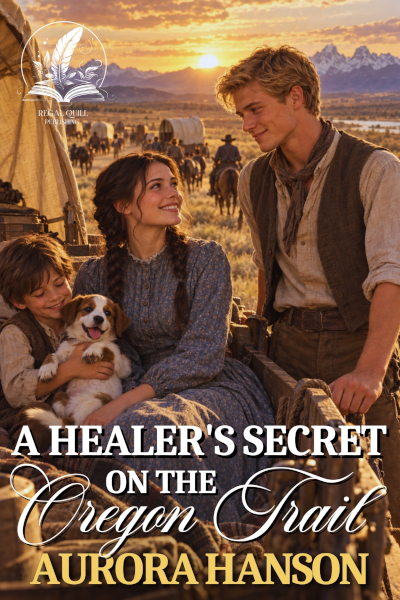
Marion turned. Theo leaned against the nearest desk, attempting an air of patience he didn’t possess. The softness had left his face, and when he smiled, Marion could already glimpse the young man he would become. Yet the same unruly lock still fell over his brow, and he still looked guilty before anyone had accused him of mischief. Boots sat beside him, broad-chested, full-grown, and utterly unaware that he was no longer a puppy.
“That depends,” Marion said, lifting her brows. “Have you been hiding beneath a bench?”
“Please. I’m too old now to hide beneath the benches. So…” Theo pushed himself upright. “Who’s coming tonight?”
Marion crossed to her desk and closed the attendance book. “Guests.”
“Hey.” He narrowed his eyes at her. “It’s my birthday. I ought to be told who will attend my own celebration.”
“Then it would cease to be a surprise.”
“I already know there’s going to be a celebration.” Theo folded his arms. “Mama’s been hiding flour for a week. And Clyde slaughtered a pig yesterday.”
Marion kept her face solemn. “It was a remarkably troublesome pig.”
“You know…” Theo tried not to laugh but failed. “You’re no better at telling the truth than you used to be.”
“No.” She reached over and straightened his collar. “I’ve become much, much better.”
“Oh, come on!” He groaned, but bent to collect her bag before she could reach for it.
Marion blew out the lamp, checked the stove, and closed the windows. When she locked the schoolhouse, the brass key turned smoothly beneath her hand. The simple weight of it still pleased her. It was proof that the valley had entrusted its children to her.
They started home on foot, with Boots ranging ahead through the grass. The road followed the creek for half a mile before climbing toward the Richards property. Cottonwoods shimmered along the water. The first wild roses had opened in the fence corners. Theo carried Marion’s bag in one hand and swung it carelessly until she warned him that the brown bottle inside cost more than his new boots.
“You told me not to ask who is coming,” he said after a while. “You didn’t say I couldn’t guess.”
Marion shook her head in amused disbelief. “I suppose I didn’t.”
“Harlan?”
Marion looked toward the hills. “Perhaps.”
“That means yes.”
“It means perhaps.”
“I knew it.” Her silence made him grin. “I know you press your lips together when you’re keeping something from me.”
Marion glanced at him. “Who taught you that?”
“Clyde.”
They reached the narrow track leading to Leroy’s cabin. It stood near the far edge of Clyde’s pasture, close enough for smoke from its chimney to be seen from the main house and distant enough to give its occupant the independence he carefully guarded. Leroy had lived with Victoria during his first two years in Oregon. A year ago, however, he had moved into the cabin and planted a garden behind it.
He was outside now, seated upon a block of cedar with a bridle across his knees. His hair had gone almost entirely silver at the temples. His hands were brown from labor and sure upon the leather.
“Mr. Seymour!” Theo called.
Leroy looked up and smiled. “There’s the birthday boy.”
Theo left the road. Boots followed.
“I’m twelve today,” Theo announced. “You said you’d teach me to shoot when I was old enough.”
Leroy’s mouth twitched. “Did I?”
“You did.” Theo nodded. “Last autumn.”
“You may be old enough to begin.” Leroy laughed. It was a full sound Marion heard more often now than she had in all the years of her girlhood. “However, whether your mother agrees is another matter.”
“She will, if you ask her.”
“Then it’s fortunate I’m walking up with you.” Leroy set the bridle inside his doorway and reached for his coat. “I’d like to see whether Mrs. Crawford’s as easily managed as you suppose.”
They hadn’t yet reached the rise above the main house when fiddle music drifted across the pasture.
Theo stopped. Below them, the yard was crowded with wagons, horses, and nearly half the valley. Long tables stood beneath the oak tree, covered with white cloths and more food than Nancy’s kitchen could have held. Men had gathered near the roasting fire, while women carried bowls from the house and called warnings no one appeared to heed.
Theo stared at it all. Then he thrust Marion’s bag at her and ran. Boots bounded after him, barking as though he had arranged the whole affair. Theo flew through the open gate just as Nancy came from behind one of the tables. She wiped her hands on her apron and he caught her around the waist hard enough to send her back a step.
Marion slowed beside Leroy. Nancy had missed four of her son’s birthdays, and since they had settled here in the Willamette Valley, she had made certain each one was worth remembering.
“Look at that,” Leroy said quietly.
Marion slipped her arm through his. “Come along, Papa.”
The sight of Clyde beside the fire brought the same small turn to her heart it had on their wedding day. He stood with his sleeves rolled to his elbows and a smear of soot along one cheek. He turned the spit while Lucille directed him from a chair beneath the oak. Her second child rounded the front of her dress, but pregnancy had done nothing to weaken her authority.
“Not so quickly,” she told him. “You’ll char one side and leave the other raw.”
“I have cooked meat before, Lucille.”
“Not for forty people, you haven’t.”
Patrick stood behind her with their firstborn tucked against his shoulder. The baby had one fist tangled in Patrick’s beard and appeared determined to remove it by the roots.
“Do as she says,” Patrick advised Clyde. “I’ve discovered that resistance only lengthens the instruction.”
Lucille turned and Patrick looked at her with the same foolish devotion he had worn since the trail. They had married one week after Marion and Clyde. Then they’d taken the northern claim beyond the pasture.
Clyde looked up and found Marion watching him. The years had changed him in small ways. The sun had drawn lines at the corners of his eyes. Work had thickened his hands. His left arm still stiffened when the rain came. Yet his smile belonged to the young man who had stood before a plain timber altar and promised her sorrow as well as joy.
He abandoned the spit to Leroy and came to meet her.
“School kept you,” he said, taking the bag from her. Then he kissed her cheek. His lips brushed against hers briefly, though the warmth of their touch stayed after he drew away.
“A little bit… Where’s Lily?” she asked.
Clyde nodded toward the porch. Victoria stood beside Harlan, holding Lily on one hip while the old wagon master entertained her with his watch. At nearly a year and a half, Lily regarded every object as something made for her personal inspection. She had both hands wrapped around the silver case and was attempting to force it into her mouth.
“Miss Lily,” Harlan said gravely, “that watch crossed the Platte without harm. I shall take it poorly if you destroy it in Oregon.”
Lily answered by guggling at him.
Victoria saw Marion and carried the child down the steps. “There’s Mama,” she murmured. “There she is.”
Lily reached for Marion at once. Marion gathered her close and breathed in the clean scent of soap and sun-warmed hair. Her daughter’s curls were golden like Clyde’s, but her eyes were Marion’s own shade of brown.
“Mama,” Lily said, patting Marion’s cheek. “Teo run.”
“Theo always runs.”
“Teo!” Lily twisted in Marion’s arms and pointed across the yard where Theo was accepting congratulations from three boys near the barn. “Teo!”
Theo heard his name and called back. “I’m here, little sister.”
The words came without thought, as they always did. No one had instructed him to call Lily his sister and yet, he had decided she was before she was born.
“Mrs. Richards.” Harlan removed his hat to Marion. He had kept in touch after they settled in Oregon, sending letters and appearing whenever his work brought him within a day’s ride. “Your schoolhouse roof’s still standing, I hear.”
“Despite your certainty that Patrick had set the rafters wrong.”
Victoria laughed. The sound remained one of Marion’s favorite things. Her sister had a small house near Nancy’s now and kept accounts for the mercantile two days each week. There were still moments when a hard knock at the door made her go still, but fear no longer ruled her life.
“Has anyone seen the guest of honor?” Nancy called.
“He was last observed attempting to discover his gifts,” Clyde answered.
From behind the barn came Theo’s indignant denial. They had only begun to set the food upon the tables when the sound of wheels reached the yard. A covered wagon appeared along the road, dust rising behind it, and before it had stopped, a brown-and-white dog leaped from the back.
Boots froze as the older dog rushed toward him. For one startled moment, Boots stood as stiff as a fence post. Then his tail began to sweep so violently that his whole hindquarters moved with it. The dogs met in a tumble of circling bodies, sniffing, barking, and racing around the wagon as though the years between them had vanished.
“Bessie!” Theo cried. “He remembers her!”
“Or he remembers being sat upon by her,” Mr. Doyle called from the driver’s seat.
Mrs. Doyle pushed aside the canvas flap before her husband could climb down to help her. “If we had trusted his directions, we’d be celebrating the boy’s thirteenth birthday.”
“We arrived, did we not?” Mr. Doyle protested.
Theo reached Mrs. Doyle first and hugged her. She held him away afterward to look at him, her eyes bright.
The meal stretched from late afternoon into evening. They ate roast pork, beans sweetened with molasses, brown bread, pickled beets, and three kinds of pie. Lucille complained that the biscuits had been left too near the fire, though no one else could detect the fault. Meanwhile, Patrick claimed the burned ones in order to stop her from feeding them to the chickens.
Stories passed around the tables with the dishes. Harlan told of a family he had guided safely through the mountains the previous autumn. Mr. Doyle told the tale of losing a boot in the Platte as his wife corrected him until even Nancy was laughing. They spoke of the trail, but not only of the trail. They spoke of Clyde’s new barn, of Patrick’s north field, of Victoria’s work at the mercantile, and of the schoolhouse children who believed every green leaf belonged in Marion’s medicine cupboard. The old journey no longer held them together by itself. Their lives, indeed, had gone on gathering new threads.
When the plates had been cleared, Nancy carried out the cake. Twelve narrow candles burned across the white icing. The wind blew across the flames and everyone crowded close to shield them with hands and hats. Theo stood behind the cake, suddenly shy under so many watching faces.
Nancy rested one hand between his shoulders. “Make a wish.”
He glanced at her. A quiet understanding passed between mother and son. Then he closed his eyes and blew. Eleven flames vanished. The last bent almost flat, recovered, and continued to burn.
“That one is stubborn,” Patrick said.
But Theo blew again and darkness took the final flame. The yard broke into cheers.
His gifts followed. Victoria had sewn him two shirts with sleeves long enough to survive, she promised, until Christmas. Patrick and Lucille gave him a pair of work gloves and a small knife with a bone handle. The Doyles brought a fine leather collar for Boots, though the dog seemed more interested in the paper that had covered it.
Harlan placed a brass compass in Theo’s palm. Its case was scratched, and the glass bore a small mark near the edge. “I carried that from St. Joseph to Oregon City four times,” he said. “It’s pointed a good many people west. I reckon it may serve one more.”
“You mean…” Theo held it as carefully as if it were gold. “You mean it’s mine?”
Harlan nodded. Theo closed his fingers around it.
“Thank you.”
Finally, Marion and Clyde led him to the barn for the last gift. A new saddle rested across the rail, plain but well made, with Theo’s initials stamped into the leather.
The boy had no words. He ran his hand over the horn and looked from Clyde and Marion to Nancy.
“A man can’t work cattle forever on a borrowed saddle,” Clyde said.
Nancy smiled through tears she made no attempt to hide. Theo hugged her first. Then he turned and caught Clyde around the middle, nearly knocking him into the rail. Marion laughed and reached for him when he finally let Clyde go. Theo threw an arm around her too just as footsteps approached.
“That’s not all.” Leroy waited until the noise had eased. “There’s one more gift, if your mother consents.” He looked at Nancy. “I told the boy I’d teach him the proper handling of a rifle when he was old enough, and I believe he may be ready to begin.”
Nancy studied her son. “Saturday morning,” she said at last. “And I shall stand beside you both.”
Theo let out a shout so loud that Boots began barking again.
“I told you she would agree,” he said to Leroy.
By the time the last wagon rolled away, the moon had risen over the pasture. Harlan and the Doyles had gone to Nancy’s house, where beds and blankets had been arranged for them. Leroy walked back to his cabin with Victoria upon his arm. Patrick carried his sleeping son toward the northern claim while Lucille followed slowly, refusing every offer of help and issuing three final instructions about the food left upon the tables.
Theo departed with his new saddle over one shoulder despite Clyde’s warning that it would still exist in the morning. Boots went with him, proudly wearing his new collar.
The house had become quiet by the time Marion carried Lily to her room. The child had fought sleep through the songs, the candles, and the opening of every parcel. But her head now rested heavily against her mother’s shoulder.
Downstairs, the porch boards creaked. Clyde sat upon the top step, his forearms resting upon his knees. The yard bore the pleasant ruin of a gathering. Chairs left in uneven circles. Crumbs on the tablecloths. And someone’s coat forgotten over the back of a chair. Beyond the fence, cattle moved as dark shapes in the moonlight.
Marion sat beside him.
“Is she asleep?” he asked.
“At last.”
He put an arm around her and drew her against his side. For a while, they listened to the creek and the faint murmur of voices from Nancy’s house as Clyde’s hand moved idly along Marion’s arm. Even after three years of marriage, there were moments when the simple ease of sitting beside him astonished her.
“You did well today,” she said.
“I turned a pig while Lucille insulted me,” Clyde laughed quietly.
“And still, you did it with uncommon grace.” She smiled. Then she looked toward the upstairs window where Lily slept. “Do you remember how long it took you to make her crib?”
“Two days of work.” Clyde glanced at the window. “Why?”
“Because…” Marion covered his hand with hers. “We’ll need another one by October.”
His gaze dropped to her waist, though there was nothing yet to see. His hand came to rest against her belly with such care that emotion tightened Marion’s throat.
“Are you certain?” he asked.
“As certain as I can be.”
His smile began slowly and transformed his whole face. He leaned his forehead against hers.
“October,” he repeated.
“If my reckoning’s right.”
Without another word, he kissed her, tender and unhurried, while his palm remained warm over the child neither of them could yet feel.
When he drew back, Marion leaned against his side and rested her head upon his shoulder. Clyde wrapped an arm around her and together they looked out across the darkened pasture. The last lamps had gone out in the neighboring houses. The creek whispered somewhere beyond the trees. And above them, the stars stretched clear and bright across the Oregon sky.
Once, those same stars had watched over them on the trail, night after night, when every mile ahead had seemed uncertain. That evening, however, they shone over their home.
Marion slipped her hand into Clyde’s and smiled. There had been hard miles, frightening ones, and miles she had believed her heart would break entirely. Yet sitting there beside him, with Lily asleep upstairs, Theo safe across the pasture, and another child quietly beginning beneath her heart, she knew she would change none of them, not one of the miles that had brought her here.
OFFER: A BRAND NEW SERIES AND 2 FREEBIES FOR YOU!
Grab my new series, "Regency Hearts Entwined", and get 2 FREE novels as a gift! Have a look here!
Aurora Hanson
September 29, 2026Hello, my dears, I hope you enjoyed the book and the Extended Epilogue! I’d love to know what you thought of the story, the romance, and the journey our characters took. I’ll be waiting for your comments here! Thank you 🙂🌹
Barbara Bundy
October 15, 2026You have written another wonderful book that showed the selfishness of some people while showing the love of others. I can’t imagine how hard the journey by wagon train really was. I am thankful for the blessings of God and his blessings on those who lived before carving a way in the wilderness.
Aurora Hanson
October 16, 2026Thank you so much, Barbara, for your beautiful words! ❤️ It’s humbling to remember the courage and faith of those who faced such hardships and paved the way for future generations. God bless you!
Janet Alecci
October 18, 2026While I enjoyed the story, you always state no cliff hangers and I think in this story it was riddled with them. I even had to put it aside at times because it became too frightening to me. I always came back to it and knew that it would eventually have a happy ending, but being old and alone, I find it difficult now-a-days to read or watch ones I refer to as scary ones. This is the 89th book of yours I have read. Please keep up the good work but make them not so scary!!
Aurora Hanson
October 19, 2026Thank you so much, Janet, for reading 89 of my books! ❤️ That truly means the world to me, and I’m so grateful for your continued support. I’m sorry this story felt a little too frightening at times, but I’m glad you stuck with it and enjoyed the happy ending. I really appreciate you sharing your thoughts with me, and I’ll certainly keep your feedback in mind. Sending you a big thank-you and a warm hug! ❤️