
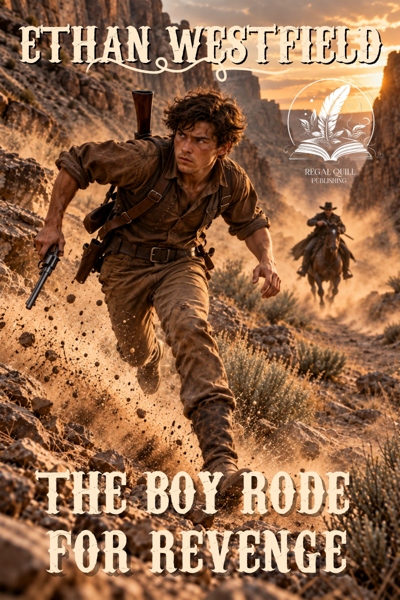
The colt had decided the saddle blanket was a bear, and Cody Shaw was letting him think it. He stood in the round pen with the blanket hanging loose from one hand while the two-year-old bay circled him at a high, ridiculous trot with his tail flagged over his back.
“He’s been at that a quarter hour,” Jesse Deakin called from the rail.
“He’s got all morning.”
“So have you, apparently.”
“That’s the whole of the trick,” Cody said.
On the fifth pass the colt stopped of his own accord, and Cody walked up and laid the blanket across his withers as though it were the most ordinary thing that had ever happened in Wyoming Territory. The bay quivered once, then lowered his head, and that was the end of the bear.
Cody was nineteen that spring. The Deakin and Shaw place ran a hundred and forty head of saddle horses, and along the south wall of the house three rose bushes stood leafed out and thorny and mean as barbed wire. They had not died in five winters, and Cody had stopped expecting them to.
His father’s Colt hung on a peg beside the kitchen door. He oiled it twice a month, the way his father had, five loaded and the hammer down on the sixth, and hung it back up and did not take it down. Jesse had asked once whether he meant to sell it. Cody said no, and Jesse never asked again, and the gun had hung there since, gathering the small ordinary dust of a house where nobody died.
He was coiling the lead rope when he heard the carriage.
It came up the valley road too fast for the road, a black rig with one horse in the traces, that horse lathered white through the breast collar, the heavy leather across his chest dark where a man had asked him to run and kept asking. The animal came into the yard blowing like a bellows, and the man in the seat did not get down. He was fifty or thereabouts, gray at the temples, in a good gray coat and a collar that had been white that morning, and his hands shook on the lines.
“You’re Cody Shaw,” he said. “Aren’t you.”
“I am.”
“Trent Young. Mayor of Wind River.” He still did not climb down. “I’ve never met you, Mister Shaw. But I’ve heard every rumor this county carries about you and a pistol, and I’ve ridden sixteen miles hoping a tenth of it’s true.”
“Walk your horse or you’ll lose him.”
“I’ll lose more than that if you don’t hear me.”
“Then talk while I walk him.”
Cody took the cheek strap and led the gelding a slow circle through the yard, and the mayor sat up there in his good coat and talked down at him.
“Charley Bell broke out of our jail last night. Him and two of his men.” Young’s voice went thin. “They killed Sheriff Rust Bigjons and both of his deputies. Rust had been sheriff for eleven years. He had a wife.”
“What was Bell in for?”
“He robbed the bank at Coalville. Killed the manager and the teller both, and the teller was nineteen years old. Two bounty hunters took him and two of his gang right in the Mustang Saloon, sitting at cards, drunk as lords. He’s been in the town’s jail three days waiting on a federal marshal.”
“Where are the bounty hunters now?”
Young shook his head slowly. “On slabs at the undertakers. Seems the second time they tried to arrest Charley Bell didn’t go the way the first time did.”
Cody kept walking the horse.
“There’s more,” Young said, and his voice came apart in the middle of it. “They’ve taken women off the street. Four of them. Herded them into the Mustang like stock. I don’t know what they’re doing in there, Mister Shaw, and God forgive me, I do know, because you can hear it from the street. One of them is Hope Johnson. Preacher Ben Johnson’s girl. She was carrying eggs to the boarding house.” He pressed the back of his hand against his mouth. “I’ve tried to raise a posse since sunup. Thirty men I asked in town, and everyone found a reason to say no. They are scared to death of Charley Bell, and they’ve earned the right to be, and I cannot make them go.”
“I don’t wear a pistol anymore, Mayor.”
“Well, son,” Trent Young said, “I need you to strap it on.”
Jesse Deakin came around the back side of the carriage, hatless, wiping his hands on a rag. He had heard enough of it to know the whole shape.
“Cody. I know how you feel about buckling that pistol on again. I’ve watched you oil that pistol for two years and not once buckle it around your waist.” Jesse put the rag in his pocket. “But if there was ever a time to buckle on the pistol, it’s this one. I know Hope Johnson. There is not a finer or gentler person alive in this valley.”
Cody handed the cheek strap to Jesse as he approached. “Water him slow. Two swallows, then walk him.”
“Where are you going?” Jesse asked.
“To get my Pa’s pistol,” Cody said.
“Praise the Lord,” Mayor Young whispered, as if saying it aloud would change Cody’s mind.
Cody didn’t glance at the carriage as he turned and headed for the house. The kitchen was dim and smelled of coffee. The peg stood beside the door at the height of a man’s shoulder, and the belt hung from it exactly as it had hung the day he put it there, the leather gone dark, the buckle still fastening two holes past his father’s notch. He had never removed the gun belt from the peg when he oiled the gun.
He looked at the gun belt a long moment as memories of the wagon train and the last time he had seen his father flashed through his mind. He took it down. The weight of it had not changed. He had thought it might. He thumbed the loading gate open and turned the cylinder once against his thumb and heard the small, oiled clicks his father had listened to every morning on the wagon train. Five live cartridges, and one empty chamber under the hammer.
Never draw one you don’t mean to fire.
“I know it, Pa,” he said, out loud, in the empty kitchen.
He buckled it on and went out and saddled the young blue roan himself. Mayor Young and Jesse were waiting outside the barn.
“My carriage horse can’t make it back to town,” Mayor Young said.
“I don’t need you for what I’ve got to do, Mayor.”
“Should I come with you?” Jesse asked.
“No, I’ve seen you shoot,” Cody said. He swung into the saddle. “I’d be more in danger of you shooting me than Charley Bell.”
Jesse smiled and shook his head as Cody touched his heels to the young blue.
Cody tried to keep his mind still as he rode the sixteen miles in a little over two hours. But images of Crow Black kept popping up in his mind, along with the men he’d killed. He thought he had put the past to bed, but here it was just as fresh, gnawing at him. As he spotted the buildings of Wind River in the fading light, he pushed the images back where they had come. “One last time,” he whispered.
The town was wrong before Cody could say what was wrong about it. Middle of the afternoon and the street bare. No wagons, no children, no horses at the rails but three standing hip-shot in front of the Mustang. Blinds drawn upstairs at the rooms, and behind one of them the shape of a face, and then no face.
Cody stopped the blue in the middle of the street and sat listening. A woman was crying somewhere inside the saloon. Then a man laughed, and the laugh went on longer than it needed to, the way a man laughs when he wants folks to hear him.
He dismounted and tied the reins to the nearest hitchrail, walked over to the saloon. He stood beside the three horses tied to the hitchrail, listening the way Crow Black had taught him to listen.
Two men laughing, and under it, closer, a girl saying no, over and over, not loud, in the flat exhausted way a person says a word that has stopped working.
Cody had been sick once at fourteen behind a cottonwood root after killing his first man. He was not sick now at the thought of what he had to do, and he took no pride in that either.
He pushed through the doors.
The room took him in all at once, the way rooms do. Lamps burning in the middle of the day. Three of the four women against the far wall by the stairs, huddled on the floor with a tablecloth pulled around them, faces turned from the door — and one of them was not crying, and that was worse than the two who were.
Two men at the bar with their backs half to him, glasses in their hands. A heavy one in a striped shirt, a smaller one with his hat shoved off a red forehead.
And straight ahead, at the round card table with the chairs kicked away, a broad-shouldered man in a black vest stood over a young woman with hair like spun gold, holding her down against the tabletop with one hand flat on her collarbone. Her dress was torn open at the shoulder seam. One shoe was off. She had both hands on his wrist and had been fighting him long enough that she had gone quiet doing it.
The man in the black vest turned his head, his eyes pale blue in a crazy way. Cody had never seen him before and knew him anyway.
“Well,” Charley Bell said. “Somebody’s boy.”
“Charley Bell?” Cody said.
“That’s the name.” He did not take his hand off the girl. “Town send you? They send a boy? That’s a poor showing after all the noise they made this morning.”
“Let her up.”
“Or?”
“Let her up,” Cody said again, and there was nothing in it. Not loud, and not a threat. A man saying a thing once.
At the bar, the heavy one set his glass down on the wood, carefully, the way a man does when he has decided to use the hand.
“Boy,” Charley Bell said, “you want to count how many of us there are.”
“I counted before I came in.”
The heavy one moved first.
Cody had spent years of his boyhood learning one motion, and five years since learning when not to use it, and none of that learning went anywhere in the next blink of an eye.
His hand closed. The barrel cleared leather. The hammer came back under his thumb, and the Colt spoke. The heavy man went back against the bar with his own pistol half out of his holster and slid down to the floor and didn’t get up.
The smaller one got his clear. Got it clear and got it up, and Cody shot him through the breastbone. The man turned all the way around once before he fell — and the second report was still ringing off the tin ceiling when Charley Bell came off the table.
He was faster than either of them. He had killed a sheriff and two deputies and two bounty hunters and a bank teller nineteen years old, and every one of them had gone down finding out how fast he was, and there was nothing at all wrong with the way he did it.
He was simply not fast enough, and he had perhaps a quarter second in which to learn it.
Cody’s third shot took him under the left eye. Charley Bell went down across the corner of the card table and slid off it and lay still in the sawdust with his pistol six inches from an open hand that would not be closing on it.
The room rang. Then the ringing stopped, and the only sound in the Mustang Saloon was a lamp chain swinging and three women by the stairs beginning to understand what the quiet meant.
Cody lowered the hammer onto the empty chamber. Two live cartridges left. He had counted them without deciding to.
Hope Johnson came up off that table.
She came off it in a rush with her hair down and her torn sleeve hanging and her one bare foot slipping in the sawdust, and she crossed the twelve feet between them and hit him in the chest hard enough to rock him back a half step, and both her arms went around his neck, and then she cried the way a person cries when the crying has been waiting a long time behind a door.
Cody stood there with a warm gun in his right hand, and his left arm around a girl he had never in his life met, and he did not say any of the things people say. He had learned from a man on a cold rim above eleven graves that most of them were built for smaller troubles.
There were bruises above both her elbows, four of them on the left, in the plain shape of a man’s fingers. Her lip was split. She had fought them the whole way from the street and the whole way across that table, and she was crying now because she had won, and because the winning had come from outside her, and both of those are hard things.
“You’re all right,” Cody said. It was not a question and not quite true, but it was the only sentence that would fit in the room.
“He wouldn’t stop. I told him, and he wouldn’t stop.”
“He’s stopped.”
The other three had not moved from the wall. They were older than Hope, and what had been done to them in that saloon had begun at ten o’clock that morning and had been finished a good while before Cody ever came through the doors. He did not go near them. He got his coat off one-handed and buttoned it around Hope to the throat, then took the clean towels off the bar, carried them halfway, set them on a table and backed away.
“Ma’am,” he said to the one who was not crying. “There a doctor in this town?”
She nodded once without looking at him.
“I’ll go fetch him if you tell me where he hangs his shingle.”
“End of the block. The whitewashed building,” the older of the three said, as tears ran down her cheeks.
“Don’t leave me here!” Hope begged. “I don’t want to be in the same room with him,” she said, her eyes going to the man in the black vest lying in the sawdust, blackened from his blood.
“Then come with me,” he said, putting an arm around her shoulder. He walked her to the batwing doors and pushed through.
“Hope!” a woman shouted from across the street when they reached the porch.
“Mama,” Hope called back, but she didn’t push away from Cody to run to the woman.
Mrs. Johnson crossed the street but stopped at the steps.
“Papa didn’t come for me?” Hope accused.
The woman lowered her eyes. “You know your father is a man of God. He can’t bear arms against a fellow man. It’s what he preaches.”
As Mrs. Johnson spoke, folks opened their doors and emerged into the street. A small man with a limp hurried across the street from the haberdashery. He paused beside Mrs. Johnson. “Hope? Is Rebecca alive?” he asked, his eyes filling with moisture.
“She’s inside, Mister McGregor, with June and Mary,” Hope replied.
“Is she all right?” McGregor asked, his voice hopeful.
“No, but she will be,” Hope replied.
“Can someone fetch the doctor?” Cody called out as several people approached the saloon.
A tall man in a blacksmith apron jogged down the street.
“Go to your mother,” Cody said, removing his arm from around Hope’s neck.
“Mister,” Mrs. Johnson said. “I don’t know how I can ever thank you for what you did.”
Hope took a step toward her mother, turned and looked at Cody. “Will I see you again, Mister?”
Cody nodded. “Ma’am, forty mules couldn’t keep me away. You see the doctor, then go home. I know you think your Pa didn’t do right by you. But he had a powerful reason not to pick up a gun. I had the same reason, but I’m not a man of God, so I did it anyway.” Cody said.
Hope nodded as her mother stepped forward and hugged her.
As Mister McGregor and several others pushed through the swinging doors, Cody walked to the hitching rail and untied the blue.
“God bless you,” a woman wrapped in a shawl called out as she climbed the steps to the saloon’s porch.
Cody touched his fingers to the brim of his hat, then mounted. As he rode away from the saloon, the quickness with which he had killed three men bore down on him like a giant hand. He felt the weight of his Pa’s pistol, no longer comforting as it had been when years ago he had ridden with Crow Black after the men who had massacred the wagon train.
He met Mayor Young on the way back to the ranch. Jesse had loaned him their carriage horse.
“Please tell me, Mister Shaw, that the women are alive?” Mayor Young stopped the carriage to ask.
“They are,” Cody replied.
“And Charley Bell and the other two?”
“Dead,” Cody said, feeling no joy in the telling.
“Thank you. The town owes you more than we can ever pay,” he said before slapping the reins against the gelding. The carriage lurched forward.
Cody didn’t urge the blue forward for a long moment. Then, with a sigh, he urged the horse into a trot. He had made up his mind what to do next. The first thing would be to hang Marcus’s pistol on the peg. The next would be to visit Hope Johnson after giving her time to recover from her ordeal at the saloon.
A week later he rode into Wind River in a coat with all its buttons and stopped at the small frame house behind the church.
Preacher Ben Johnson was splitting kindling in the side yard. He gathered three sticks across his knee at once and snapped them off with three strokes of his big hands—crack, crack, crack —and Cody stood at the gate a moment before he could make himself go through it.
“Mister Shaw is it? “
“Yes, Reverend Johnson.”
The old man set down the hatchet and wiped his palms on his trousers. “You’ll be wanting to see Hope.”
“I’ll be wanting to ask you something first.”
“Then ask it.”
Cody turned his hat once in his hands. He had rehearsed it on the ride to town, and it had come out fine every time, and now none of it would come at all. He cleared his throat and tried anyway.
“I’d like your permission to call on your daughter, sir. Properly. To court her, if she’ll have it and you’ll allow it.”
Johnson looked past him at the road a good while.
“You killed three men in front of her,” he said.
“Yes, sir.”
“I’ve had that in my mouth every day for a week, and I cannot get it to sit right or sit wrong. My whole life’s work says a man ought not do what you did in that saloon.” He looked back. “And my daughter is upstairs in this house instead of in the ground, and I have thanked God on my knees every night since for the man who walked through those doors. Both things happened. I don’t know how to make them one thing.”
“I don’t either, sir. I gave up trying a while back. A man I knew taught me that when two true things won’t fit together, you carry them both anyway.”
The preacher’s mouth moved slightly under the beard. “That’s better theology than most of what I preach.” He picked up the hatchet, looked at it, and set it down. “And the gun?”
“On a peg by my kitchen door since the day after. I don’t aim to take it down again.”
“Can you promise me that?”
“No, sir,” Cody said. “I could say it, and I’d mean it standing here. But I said it once before, and then Mayor Young drove his carriage into my yard. I’d rather not lie to you the first time I stand in your gate.”
“Your folks. They’d have raised a boy who’d answer a question that way, I expect.” He turned toward the house, put two fingers in his mouth and whistled once, then went back to his kindling without looking up. “She’s sat at that upstairs window every afternoon this week. I never once asked her what she was watching the road for. Go on and sit on the porch, son. There’s a bench. It isn’t much of a bench.”
Hope Johnson came out through the screen door with her hair pinned up and long sleeves buttoned at both wrists. She stopped when she saw him, and her face did a thing that took several seconds and ended somewhere near a smile.
“You came.”
“I said I would.”
“People say a lot of things.”
“I know it,” Cody said. “That’s about the only thing I own that’s worth anything. When I say a thing, it holds.”
They sat on the bench with a decent foot of daylight between them, and behind the house her father had gone back to splitting kindling in threes—crack, crack, crack—enough space between to hear every word and far enough to pretend he couldn’t.
That fall Cody brought her out to the valley to see the place, and she stood a long while at the south wall of the house, where three rose bushes that had crossed an ocean and half a continent in a wooden crate stood blooming for the fifth straight year.
“They’re beautiful,” she said. “Who planted them?”
“A woman named Anneke Ostermann. She never got to see the valley. I planted them for her.”
Hope turned one bloom toward herself with two fingers, gently, the way a person touches a sleeping child.
“Then we’ll have to grow more of them,” she said.
OFFER: A BRAND NEW SERIES AND 2 FREEBIES FOR YOU!
Grab my new series, "Regency Hearts Entwined", and get 2 FREE novels as a gift! Have a look here!
Ethan Westfield
November 2, 2026Hey there, I really hope you liked my new western adventure story and the extended epilogue! I would be very glad to read your comments below.