
Three years.
He had counted them, once, as a man counts down from something. Three years to marry. Three years to produce an heir. Three years before the estate reverted to a sheep farmer in Yorkshire he had never met.
He did not count them that way now.
What he counted now, on a Tuesday morning in July with the lake bright in the distance and the lawn full of noise, was something considerably less precise and considerably more worth the counting: the number of times his son had attempted to eat grass in the last hour, which was four, and the number of times Tobias had found this funnier than the situation strictly warranted, which was also four, and the number of minutes since Mrs. Pritchard had declared the whole family ungovernable and then stayed to watch anyway, which was approximately thirty.
Sebastian Wycliffe was ten months old, and had the hair that Alistair had had at that age, which he knew from a portrait in the gallery that Honoria had found in October and had made no attempt to conceal her delight in. He also had, improbably, Honoria’s eyes, which meant he looked up at the world with a clarity that was slightly unnerving in someone who could not yet reliably sit upright without tipping sideways.
He was sitting upright now, in the middle of the lawn, regarding a blade of grass with the focused interest that preceded its fifth attempted consumption.
“He’s going to eat it,” Tobias said.
“He’s not going to eat it,” Alistair said.
Sebastian ate it.
“You were saying,” Tobias said.
Tobias was ten, and had grown in the way that boys grow when they are not paying attention to it themselves, all sudden angles and a voice that was occasionally surprising to its owner. He was still the careful, serious child who had stepped off a carriage with a governess and said very little for a week, but the carefulness now had something easy underneath it, something that had arrived gradually over three years in this house, in this landscape, with these people, and which Honoria called settled and Alistair called home.
He removed the grass from his son’s mouth. Sebastian looked at him with an expression of serene disapproval and immediately reached for a different piece.
“Sebastian,” Alistair said.
Sebastian looked up, considered him, and decided to eat the grass anyway.
“He has your determination,” Honoria said, arriving with two glasses of something cold and sitting on the blanket beside him.
“He has your complete absence of interest in being told what to do,” Alistair said.
“Those might be the same thing,” she said pleasantly.
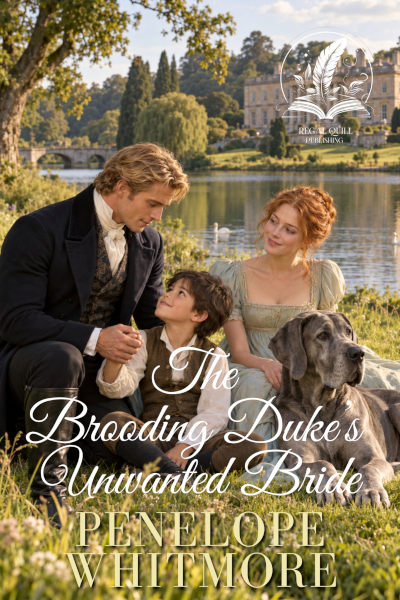
Across the lawn, Tobias had given up on the grass situation and was conducting what appeared to be a complex negotiation with Brutus. The dog was greying at the muzzle now, moving at a slightly more considered pace than he had when he’d knocked Honoria into the lake seven years ago, though his enthusiasm for any activity involving Tobias remained entirely intact. They were engaged in something with a ball that had no clear rules but enormous conviction on both sides.
“Nicholas is going to wear a hole in the garden,” Honoria said.
Alistair looked to where Peregrine was standing near the roses, ostensibly in conversation with Rupert, but actually tracking Georgina’s position every thirty seconds with the regularity of a man who has identified a concern and cannot stop attending to it. Georgina was heavily pregnant, serene, and entirely unbothered by her husband’s anxiety, which she had been managing for four months with the same patient competence she brought to everything.
“She’s going to be fine,” Alistair said.
“I know that,” Honoria said. “Nicholas knows that. His body hasn’t quite accepted it yet.”
Rupert appeared to say something to Peregrine that produced a short, reluctant laugh. Rupert had become, over the last three years, a person Alistair found he could share a room with without calculation, which was more than he had expected and less than Honoria had hoped for, and probably exactly right for what Rupert actually was. The arm had healed cleanly. The man had healed in the way men heal when they have done one thing they are genuinely proud of and have spent subsequent time working out what it means about the rest of their choices.
Dorothea descended on Tobias from the direction of the house, accompanied by Mrs. Pritchard, the two of them moving with the coordinated purpose of people who have identified a situation that requires intervention. The situation, Alistair gathered from the distance, was that Tobias had apparently decided to give Sebastian a ride on his back.
“I was being careful,” Tobias said, loudly enough to carry across the lawn.
“You were being ten,” Dorothea said.
“Those are not the same thing.”
“They are more similar than you know,” Mrs. Pritchard said, taking Sebastian from Tobias’s back with the efficiency of long practice and settling the baby on her hip, where he grabbed her cap and appeared very pleased with himself.
“He likes it,” Tobias said. “He was laughing.”
“He laughs at Brutus falling over his own feet,” Dorothea said. “His standards for entertainment are not a guide to what is advisable.”
Tobias looked at Alistair across the lawn with the expression he used when he felt a decision had been made unjustly and was appealing to the higher authority.
Alistair kept his face entirely neutral.
“That’s not helpful,” Tobias said, reading the neutrality accurately.
“I didn’t say anything,” Alistair said.
Tobias turned back to negotiate further with Dorothea and Mrs. Pritchard, who presented a united front that showed no signs of yielding. His voice carried across the lawn in the particular register of someone who is making excellent points that are not being given sufficient consideration.
Honoria was watching the whole of it with the expression she wore on good afternoons, when she had permitted herself to notice how much she had to look at.
Sebastian, having returned from Mrs. Pritchard’s hip to the blanket, made another attempt on the grass. Alistair removed it before it arrived. Sebastian gazed at him with thoughtful disapproval.
“He really does have your eyes,” Alistair said.
“He has his own eyes,” Honoria said. “That’s what everyone says about Tobias and they are mistaken. Both of them have entirely their own eyes. They simply aim them in our direction.”
He looked at her. She was watching the lawn, the two older women and the boy and the dog and the baby and the roses and Peregrine’s anxious circling, watching it with the particular quality of attention she had always brought to things she intended to keep.
“There is something I want to tell you,” she said.
Her voice was the same as it always was, nothing in it to indicate this was different from any other Tuesday in July. He had learned, over three years, that this was precisely when she said the things that mattered most, when her voice was most ordinary, when she had been turning something over long enough to be ready.
“Tell me,” he said.
She looked at him then, and held it for a moment before she spoke.
“I have been writing to Cecily,” she said.
He was very still.
“Since December,” she continued. “She wrote to me first, from the institution in Wiltshire. Her family passed the letter through, I think they were uncertain whether I would receive it, but I did. She was asking for forgiveness.” She kept her eyes on his face, watching him take it in. “I wrote back.”
“Honoria,” he said, and stopped, because he did not yet know what to put after it.
“I know,” she said. “I know what you are going to say, or some of it, so let me say my part first.” She turned the glass in her hands, the same habit Tobias had, the same one that was not actually Tobias’s at all but hers, absorbed somewhere between the nursery and the lawn. “She tried to kill me. I understand that. I have not forgotten it, and I am not pretending it was smaller than it was. But she is in an institution in Wiltshire and she is not well and she has no one near her, and she wrote to me in a handwriting that was not quite the handwriting I remembered from the note.” She paused. “I did not write to be kind. I wrote because I needed to, for my own sake. And what I told her was that I forgave her, and that I asked in return that she leave my family alone. All of it, permanently. And she wrote back and agreed.”
He looked at her. He looked at his wife, who had been pushed into a lake on a cold October afternoon by this woman, who had managed a frightened child at the end of a pistol, who had spent the evening of that day telling him she loved him in a ruined chapel, and who had spent the subsequent three years being exactly who she had always been, and had apparently, quietly, somewhere in December, written a letter of forgiveness to the woman who had tried to kill her.
“I am not entirely comfortable with this,” he said.
“I know,” she said. “You don’t have to be.”
“I want to understand it.”
“I’m not sure I can explain it in a way that will make it entirely comfortable,” she said, honestly. “I can only tell you that she was not well, and I believe she is less dangerous to herself and to everyone else in an institution than she would be with that letter unanswered and whatever it contains festering in her. And I can tell you that carrying something that large costs more than setting it down.” She looked at him steadily. “I know that isn’t the same as saying it was the right thing. I am saying it was what I needed to do, and that it is done, and that I am telling you now because I don’t keep things from you anymore.”
He was quiet for a long moment.
Across the lawn Tobias had apparently reached the end of his negotiation with Dorothea and had conceded the point, because he was now sitting beside Sebastian on the blanket in the posture of a boy who has accepted a verdict and is making his peace with it by pretending to choose it. Sebastian grabbed his finger with the focused intensity of a baby who has identified something interesting.
“You wrote to her,” Alistair said, “so that she could not keep being a thing in the air between us.”
“Yes,” Honoria said. “Partly that.”
“And partly because you couldn’t not.”
She looked at him with something in her face that was not quite a smile. “You have been learning me for three years,” she said. “You are occasionally inconveniently accurate.”
He looked at the lake, bright in the July light, and thought about a solicitor with a ledger who had told him three years was not a great deal of time for a gentleman who had avoided society rather thoroughly. He thought about what he had done with those three years, and what they had made, and he thought that the particular quality of grace it took to write a letter like that to a woman like Cecily was not something he was sure he could have managed himself, and that this was not the first time Honoria had been capable of something he was not, and that he had stopped finding it surprising and had begun finding it one of the most reliable facts of his life.
“I’m not comfortable,” he said again. “But I understand it.”
She nodded.
“Don’t write to her again,” he said.
“I don’t intend to,” she said. “It was one letter. She answered it. That is the end of it.”
“All right,” he said.
She put her hand over his where it rested on the blanket, and he turned his palm up and held it, the same way he had in the church at Peregrine’s wedding, the same way it always went between them now.
“Daddy,” Sebastian said.
They both looked at the baby.
Sebastian was looking directly at Alistair, with the expression of a person who has said a thing and is waiting to see what happens next.
The word had arrived before, tentatively, in the way that first words arrive, but usually to the general vicinity of the room rather than aimed at anyone in particular. This was different. This was aimed.
Alistair looked at his son. Sebastian looked back at him with Honoria’s eyes and his own serious expression and the blade of grass he had retrieved from somewhere that Alistair had clearly missed.
“Yes,” Alistair said. It came out not quite steadily, which he allowed.
Sebastian, having successfully deployed his word, appeared to consider the matter settled and returned his attention to the grass.
Tobias looked up. He had heard. His face arranged itself through several expressions very quickly: surprise, recognition, something considerably softer than either.
“He said it,” Tobias said.
“He did,” Honoria said, and her voice was not quite steady either.
“He’s been practicing,” Tobias said. “I’ve been hearing him in the mornings. I didn’t want to say anything in case he stopped.”
“You knew,” Alistair said.
“I knew he was close,” Tobias said, with the considered fairness of someone who wants to be accurate. “I didn’t know it would be today.”
Across the lawn Peregrine had finally been persuaded to sit down, Georgina at his side with her hand in his, the two of them quiet in the way people are quiet when they have said the important things and are resting in the aftermath of them. Rupert was throwing the ball for Brutus, who was retrieving it with dignified enthusiasm. Dorothea and Mrs. Pritchard were in conference over something that looked important and probably concerned a picnic.
Tobias was still watching Alistair, the expression still on his face, the soft one that did not announce itself.
“I was here first,” Tobias said, conversationally.
“You were,” Alistair agreed.
“I just wanted to note that,” Tobias said.
“Noted,” Alistair said. “It is not a competition.”
“I know that,” Tobias said. “I’m just noting it.”
Sebastian, satisfied with the afternoon’s achievements, leaned sideways and put his head on Alistair’s knee and closed his eyes, the way he did when he had decided sleep was the appropriate next step and intended to take it wherever he happened to be.
Alistair put his hand on the back of his son’s head, very gently.
Honoria was watching him. He knew the quality of it without looking, the particular attention she paid to moments she intended to keep. He looked up anyway, because he liked to see her face when it was like this, open and warm and not performing anything for anyone.
“All right?” she asked, quietly.
“Yes,” he said. “Better than.”
She leaned against his shoulder, her head light and certain against him, and they sat in the July sun while their son slept on his knee and Tobias threw the ball for the dog and Brutus fetched it with the grey-muzzled persistence of an old friend doing what he has always done, and the lake lay bright and easy in the distance, simply part of the day.
OFFER: A BRAND NEW SERIES AND 2 FREEBIES FOR YOU!
Grab my new series, "Regency Hearts Entwined", and get 2 FREE novels as a gift! Have a look here!
Penelope Whitmore
October 6, 2026Hello, dear readers! I hope you enjoyed this love story. Let me know your thoughts, did you expect a different ending? I’m excited to read your comments. Thank you!