
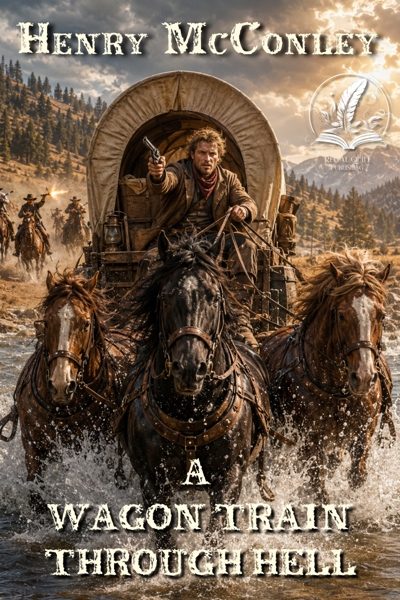
 By the time Reese reached Grey Rock, summer had burned itself out.
The trip west had taken months. Long enough for the Missouri heat to give way to cool nights, for green leaves to turn yellow along the trail, and for Reese to question the wisdom of the journey at least once every day.
He hadn’t traveled alone.
There were no wagons this time and no families depending on him to find a safe crossing. He rode with a small group of merchants as far as the Oregon border, then joined a freight outfit heading toward the coast. They were loud, cautious men who played cards badly and complained about coffee as if poor coffee were the worst danger on the trail.
Reese found their complaints comforting.
Nobody drowned. Nobody hunted them for papers. When gunfire cracked one night, it was only a farmer scaring wolves away from his livestock.
An ordinary trip.
He had forgotten those existed.
Grey Rock appeared beneath a pale afternoon sky, huddled against the rough Oregon coast almost exactly as he remembered it. The cliffs rose dark beyond town. Gulls wheeled overhead, their cries carried inland by the wind. Salt sat heavy in the air.
Reese stopped Jameson on the ridge above the road.
The horse had gone grayer around the muzzle. Reese supposed they both looked older than when they left.
“There it is,” he said. Jameson flicked one ear. “Don’t seem too excited.”
The town had changed, but only in small ways. There was a new roof covering the general store. The blacksmith had added another shed. Several houses stood where empty lots used to be, and the sign above the saloon had been repainted.
None of the changes were large enough to make Grey Rock feel unfamiliar.
That was worse.
Part of it still felt like home in the way that almost every bit of it held a version of Reese Bolden inside of it. He saw himself running barefoot past the mill road with his sister. He saw his mother coming out of the store with flour balanced against one hip. Near the saloon, he remembered stumbling into the street with whiskey in his blood and his father’s death still too large to understand.
He didn’t stop there.
People looked at him as he rode through town. Some recognized him. Amos Green stood outside the saloon and stared openly, a bar towel thrown over one shoulder. Reese lifted two fingers from the reins. Amos returned the gesture.
No one came running to ask where he’d been.
Reese was grateful for that.
He passed the road that led to the Bolden farm. His hands tightened around the reins, but he kept Jameson pointed toward the farm.
When he pulled up to the house, his heart almost stopped.
He swung down and looped Jameson’s reins over the post out front, taking his time with the knot the way a man does when he isn’t ready for what’s past it. He checked the girth, though it didn’t need checking. Ran a hand down the horse’s nose. Let a full minute pass with nothing but the wind and the gulls before he made himself walk instead of stand there.
Then, instead of climbing the porch steps, he circled the house—the same worn path he’d walked a hundred times as a boy, past the corner where the rain barrel used to catch the runoff, out toward the back where the ground sloped gently beneath the old sycamore.
He carried flowers wrapped in brown paper under one arm. They had looked better when he bought them from a woman in town that morning. The ride and the wind had battered them, bending two stems and scattering several petals.
His mother would have laughed. She never trusted a flower that couldn’t survive being carried home.
Reese pushed himself to make the corner around the house. He knew where his mother and sister were buried. He had stood beside both graves years before, first numb, then angry, while his father stared at the earth as though he meant to climb into it with them.
But his heart stopped when he saw the graves—because there were stones there.
Jane hadn’t just bought his father’s stone, but his mother’s and sister’s too.
His mother rested on the left.
MARGARET ANNE BOLDEN
BELOVED WIFE AND MOTHER
His sister lay beside her.
SARAH ROSE BOLDEN
BELOVED DAUGHTER AND SISTER
And next to Sarah stood a stone of gray granite, darker than the others.
JOHN ELIAS BOLDEN
BELOVED HUSBAND AND FATHER
Jane had done exactly what she’d promised and then some. He stopped.
For most of the journey, he had imagined this moment. He thought he might cry. He thought he might fall to his knees, curse his father, forgive him, or demand to know why he hadn’t waited one more night.
Instead, Reese stood holding a bundle of damaged flowers and listened to the wind carry salt water. He closed his eyes and let it wash over him.
The grief was there. It would always be there, but it no longer felt like a hand around his throat.
“Hello,” he said, his voice sounding strange to himself.
Then he moved and crouched by his mother’s grave. Weeds had grown around the base of the stone. Reese set the flowers down and pulled the weeds free one at a time, shaking dirt from their roots.
“Sorry it took me so long.”
He cleaned Sarah’s next, then his father’s. Wind had piled dead leaves against one side, and Reese brushed them away with his hand.
John’s grave had settled evenly. No crooked wooden cross. No lonely patch of dirt behind a dying farm.
He was with them. Reese sat in the grass.
“I reckon you already know most of what happened,” he said. “If folks are right about where you went.”
He looked at his mother’s name.
Margaret Bolden believed the dead could see the living. John always said heaven had better things to offer than watching fools make trouble for themselves, but Margaret insisted family didn’t stop being family just because one side could no longer answer.
Reese hadn’t believed either of them. Now he hoped his mother was right.
“I left,” he continued. “Morning after Pa died. Myles took me with him.”
The wind lifted his hair and chilled the sweat at the back of his neck.
“He took care of me. Tried to, anyhow. You’d have liked him, Ma. Pa already did.”
Reese pulled one knee to his chest.
“He didn’t make it.”
There was no gentle way to tell that part, even to stone.
“Myles died at a river crossing. The Mandelsons did, too. Both children. Joe went back after the men who did it, and I never saw him again.”
He paused.
“I think he died. I hope I’m wrong.”
Reese had looked for Joe’s name in every town where news traveled. He asked merchants, trappers, soldiers, and men passing east from Oregon. No one had seen him.
For a long time, Reese imagined Joe was still out there. It was easier than admitting what he already knew.
He plucked a blade of grass and rolled it between his fingers.
“Wildcat’s dead. Bobby, too.”
The words vanished into the wind.
His father had known Wildcat since they were boys. Reese wondered what John would feel hearing that both Walters brothers were gone. Relief, probably. Sadness, maybe, for the children they had been before hunger and cruelty made them something else.
“I rode with Wildcat,” Reese said.
He looked at the women’s stones.
“I did things I’m ashamed of. Hurt people. Killed men. Told myself it was for the farm. For Pa. But that didn’t matter.”
He had rehearsed no confession. The truth came out rough and unorganized, the way most truths did when nobody interrupted.
“I can’t make any of it right. Not all the way.”
One of the flowers’ petals blew off in the wind. Reese reached out and caught it before it rolled down the hill.
He separated the bundle into three smaller groups. His mother received the yellow flowers. Sarah got the purple ones she would have called too pretty to pick. Reese placed the remaining white blooms in front of his father’s stone.
“I sold Meyer those deeds,” he told John. “Made him pay a damned fortune for them.”
He almost apologized for swearing, then remembered his father had taught him most of the words he knew.
“Felt wrong. Still does, some. Like I let him decide what your life was worth, except I was the one who named the amount. But I used it.”
This was the part he had come to tell them.
Reese wiped his palms against his knees and straightened where he sat.
“I started a fund in Missouri. Farmers put money in when they can, and we lend it back out when somebody has a bad season. We charge enough to keep it running. Not enough to take their land.”
He smiled faintly.
“You’d hate the office, Pa. Too much paper. I’m getting good at it, though. I can read a ledger now without wanting to throw it in the stove.”
He told them about the first farmer the fund helped, a man who lost two workhorses before planting. Reese left out his name. He told them about the widow who joined in her own right and argued with every man in the room until they changed a rule that made no sense. He spoke about the farmers who contributed after good harvests, and the families who came into the office frightened and left with enough time to breathe.
None of it sounded grand when he said it aloud.
That pleased him. Grand things had caused enough trouble.
This was simply useful.
“Pa,” Reese said, turning to his father’s stone, “your debt’s paid.”
The sentence shook more than he expected.
“All of it. Jane saw to that. Bank gave her a receipt. Your name’s clear.”
He pulled the folded paper from his coat. The creases had softened from being opened so many times. Reese rested it against the base of the stone, holding one corner beneath a small rock so the wind wouldn’t take it.
“I know that mattered to you.”
His eyes burned.
“I wish it hadn’t mattered so much.” Tears came then. Not violently. Nothing like the night Jane held him beside the fire while every loss he carried broke loose at once.
These tears were quiet.
Reese wiped his face with his sleeve.
“I was angry with you,” he admitted. “Still am, once in a while.”
He could say that now without feeling disloyal.
“You should’ve waited. I was coming home with enough money. More than enough. I keep thinking if I’d ridden faster, or if Wildcat gave me the chest sooner, or if I’d said something different before I left…”
Reese stopped himself.
He had traveled that road until there was nothing left on it.
“But I know it wasn’t one night. It was Ma. Sarah. The farm. The debt. All of it, year after year.”
He looked from one headstone to the next.
“I forgive you.”
The words didn’t change the sky. No warmth passed through him. His father’s voice didn’t rise out of the wind.
Still, Reese meant them.
“And I’m trying to forgive myself.”
He sat with his family until the sun dropped lower over the water. Gray clouds broke near the horizon, letting through a narrow band of gold. The light reached across the waves and caught the edges of the headstones.
For years, Reese remembered his family only through sickness and death. His mother sweating through a fever. Sarah too weak to lift her head. His father hanging in the barn.
Now other memories returned.
Margaret singing, badly and without shame, while she kneaded bread. Sarah hiding a frog in Reese’s bed and laughing so hard she gave herself away before he found it. John teaching him to guide a plow, one hand over Reese’s while the earth opened in a dark, straight line behind them.
Reese laughed. “You remember that frog, Sarah?”
The stone said nothing, it never could. But he swore he could hear her laughter anyway. He leaned back on both hands.
“I’m doing all right,” he said. “Thought you should know.”
That was the truth of it.
Not perfect. Not healed in all the places hurt had found him. Some nights he still woke up reaching for a pistol. He still chose the chair against the wall and watched strangers’ hands. Certain sounds pulled him back to the river before he could stop them.
But he had work worth doing.
He had people who expected him in the morning. He had begun to want years he once couldn’t imagine surviving.
“I met somebody,” Reese said.
The admission made him feel foolish enough that he looked over his shoulder. The cemetery remained empty.
“A woman in town. Missouri, I mean. Not here.”
He picked at a loose thread on his sleeve.
“She’s nice.”
That sounded inadequate.
“She’s more than nice. Smart. Don’t put up with much from me. Her father has a farm outside Independence and came into the fund last spring. She does his figures because he’s worse with numbers than I was.”
Reese smiled down at the grass.
“She works at a restaurant,” he said. “Kind. Smart. Tells me when I do things wrong and isn’t afraid to do it in front of everybody.”
His mother would have liked that.
Sarah would have demanded to know whether the woman was pretty.
“She is,” Reese added, answering the question before his sister could ask it in his head. “Pretty, I mean.”
Wind moved through the cedar branches.
“Nothing’s decided. We’ve taken some walks. Had supper twice. I’m going to ask her again when I get home.”
Home.
The word came easily.
Reese looked out over the land of Grey Rock. From the hill, he could see the edge of town, the road leading south, and beyond it the land his father once tried to save.
That had been home.
Part of him would always belong to it, but he no longer mistook belonging for a command to stay.
Missouri waited for him now. The office, the ledgers, Jameson’s stall at the boardinghouse, and a young woman who corrected his arithmetic without apology.
He got to his feet and brushed the grass from his trousers.
“I ought to go.”
The light had begun to fade. He gathered the brown paper and tied it into a small bundle, leaving the flowers where they rested.
At his father’s stone, he stopped.
“I hope you’re proud of me,” he said. “Actually, I think you are.”
Reese walked back to Jameson. The horse nickered when he got back to him, ready for supper no doubt. Reese untied him and climbed into the saddle. From there, he thought of the three stones memorializing his family.
The graves no longer looked like proof that he had been left alone. They looked like a family resting together.
Reese touched two fingers to the brim of his hat.
“I’ll come back,” he promised.
Then he turned Jameson toward town. The road descended from the cemetery in a long, easy slope. The flickering light of lanterns had begun appearing in Grey Rock’s windows, one after another. Reese followed them.
Grey Rock wasn’t his home anymore… but he wondered if it could be again.
OFFER: A BRAND NEW SERIES AND 2 FREEBIES FOR YOU!
Grab my new series, "Regency Hearts Entwined", and get 2 FREE novels as a gift! Have a look here!
Henry McConley
August 31, 2026Hey there, I really hope you liked my new western adventure story and the extended epilogue! I would be very glad to read your comments below.