
Three years later
Oberon was five years old and had not stopped talking since the evening in the study. A bargain Evan considered, without any real competition, the finest thing their family had ever received. He had just informed his grandmother, with total confidence and no apparent concern for her feelings on the matter, that the portrait of his grandfather looked like a man who had made a great many poor decisions in his life. The dowager had studied the portrait a long moment, telling him he was not wrong. The two of them had gotten on considerably better since that particular exchange than either of them had managed before it.
Elizabeth was fourteen months old and followed her brother into every room he left, on legs that had only recently learned to be trusted with the business of walking. Oberon tolerated her the way an older brother tolerates an apprentice he never asked for and would not give up. Visible impatience sat over loyalty so complete it needed no defending, and he had already appointed himself the person who decided which of his own treasures she was permitted to ruin.
He had, in the last year, taken to horses the way some boys took to soldiers or ships, and could be found most fine mornings down at the paddock with Letitia, mounting a pony of his own with a competence that had nothing left in it of his mother’s own first, wobbling attempts on Juniper’s broad and patient back. Evan liked to watch the two of them from the stable yard some mornings without announcing himself, Letitia’s voice carrying across the grass in the same low, instructive tone she’d once used on a governess’s reluctant pupil, and found, watching it, that certain mornings had simply become his favorite hour of any given week without his ever having decided that they should.
***
It was Evan’s birthday, and the house stood under a kind of happy occupation it had not known in living memory.
Cornelius and Aoife arrived before noon with their own child, nine months old and considerably louder than both his parents combined. Cornelius had the look of a man who had given up altogether on the idea of sleep and made his peace with the loss some months back. His own parents had not come to their wedding. But they had found their way back to each other since, in letters and then in visits. Aoife had not cooked in the Cartwright kitchen in three years, unable to help herself by reorganizing it within the first hour of arriving, a habit Mrs. Pell permitted from no one else.
Mrs. Pell herself had stayed on at Cartwright through all three years, and had grown, in that time, into something closer to family than staff, a change Evan credited in no small part to an afternoon he had never asked either woman to account for and never would. Whatever had passed between his housekeeper and his wife in the days after Seline’s arrest, it had settled something old and unspoken between them. Mrs. Pell’s sister and her three children came up from the Ferrers cottage twice a year since for a proper visit, the tenancy as secure as any deed could make it, and nobody in the house ever spoke of the arrangement as anything other than ordinary.
On the lawn, Silas Weston was down on his knees being a horse, badly, the way he did four times a year, Oberon shrieking with delight at his complete lack of talent for the role. The dowager watched from beneath a parasol, Elizabeth in her lap pulling the fringe loose one thread at a time, and something in the old woman’s face had settled into something Evan no longer expected to arrive with any particular ceremony. It was not forgiveness exactly. He had stopped waiting for a moment that announced itself as forgiveness, because he had come to understand such moments rarely arrived that way.
Oberon abandoned his grandfather mid-gallop and came pounding across the lawn to where his grandmother sat under her parasol, breathless and triumphant, Elizabeth’s fringe-thread project entirely forgotten the moment he arrived.
“Grandmother, did you see? I made him neigh three times.”
“I counted four,” the dowager said, “though I’ll allow the last one sounded rather more like a man who had stepped on something sharp.”
“That was the fourth one on purpose.” Oberon considered it a point of professional pride. “He’s a very bad horse. The worst horse I’ve ever ridden.”
“He does try.”
“He tries very hard,” Oberon said it the way he said most things, without a trace of unkindness in it, simple reporting rather than complaint. He climbed up onto the bench beside his grandmother without waiting to be invited, which he never did anymore, and peered over at Elizabeth. “Is she eating the fringe again?”
“She is.”
“She’ll be sick.”
“She will.”
“Should we stop her?”
“We could,” the dowager said, “or we could let her learn it herself, the way you learned about the strawberries.”
Oberon considered the wisdom of her words with visible respect. “I only did that once.”
“You did.”
He was quiet a moment, watching Elizabeth work a thread loose with enormous concentration, then turned back to his grandmother with a directness that had, three years running, never once worn off. “Papa says it’s his birthday. Does that mean he gets older, or does everyone get older and it’s just his turn to be noticed about it?”
“That is,” the dowager replied, “a considerably better question than most people your age manage to ask.”
“I know,” said Oberon, entirely without arrogance, the way he might have said the sky was blue, and slid down off the bench to go ask the question to his father directly, already certain of getting a proper answer.
What sat on the lawn then, watching Silas make a fool of himself for the entertainment of two children, was thirty-seven years late, and it was there regardless. Evan had learned to count that as enough.
Seline had been tried that autumn and had given the court precisely what she had once given the drawing room: composed, reasonable responses, and utterly without remorse. She had been transported in the new year. Her father had come to Cartwright on his knees before the trial, and Evan had let him keep the eastern acres bringing no charge against the man himself. Not out of any mercy for Lord Ferrers, whom he did not particularly wish to see again, but because his sister’s son was not going to grow up carrying the weight of being the reason a family had been ruined.
Everyone in the county finally referred to the boy by his given name. It sat in the parish register in the duke’s own hand, entered properly beneath his mother’s name at last, thirty-four years after she should have been recorded there in the first place.
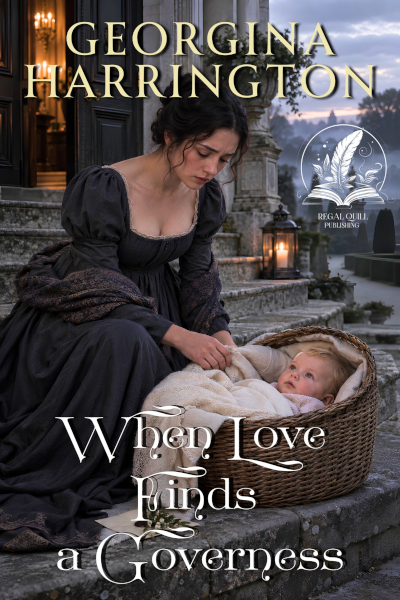
That evening, once the last of the guests had left and the house had settled into its ordinary quiet, Evan found his wife standing at the nursery window, watching nightfall come down over the garden. He crossed the room and put his arms around her from behind. He thought, standing there with his chin against her hair, of a child left on his front step in a blanket he had not been able to explain, and of everything that single blanket had eventually unraveled. The house was quiet. And everyone in it was his.
THE END
OFFER: A BRAND NEW SERIES AND 2 FREEBIES FOR YOU!
Grab my new series, "Regency Hearts Entwined", and get 2 FREE novels as a gift! Have a look here!
Georgina Harrington
September 22, 2026Hello, dear readers! I hope you enjoyed this story. What did you think about the ending? I’m excited to hear your thoughts in the comments. Thank you!